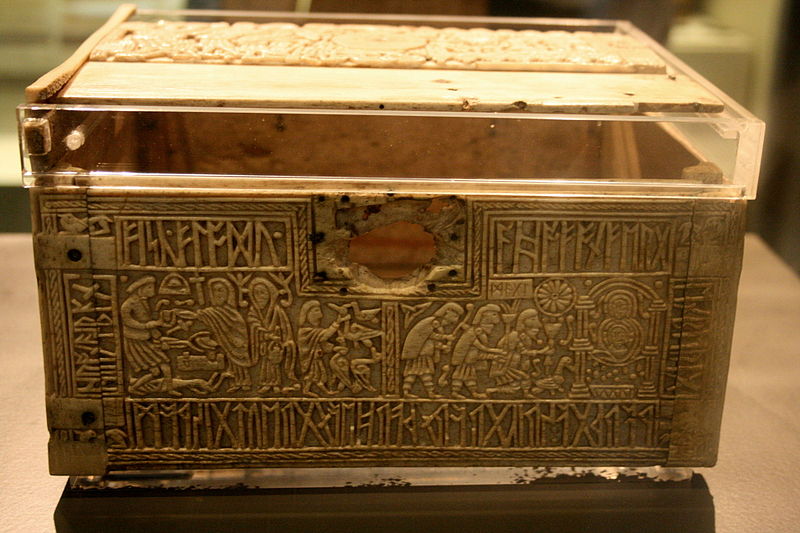
Figure 1. The Franks Casket
Photo Michel Wal
Click on images for links to more detailed photos
The Casket is generally attributed to early eighth century Northumbria, the milieu of the Venerable Bede (673-735), and known as the "Golden Age of Northumbria" (Hawkes and Mills, 1999). Three of the panels are well understood to represent the founding of Rome by Romulus and Remus, the conquest of Jerusalem by Titus, the Adoration of the Magi, and a tale from Germanic mythology, the revenge of Wayland the Smith. The lid is more controversial, but three scholars have associated it with various scenes from the Trojan War.
The fifth panel is least well understood, but was definitively explained by A.C. Bouman in 1965. Bouman compellingly interprets the right panel as celebrating the brothers Hengist and Horsa who, according to both Bede and the Anglo-Saxon Chronicle, founded England in the mid-fifth century A.D. In particular, it depicts Hengist mourning Horsa after he died at the battle of Aegelesthrep in 455 A.D.
Although Bouman did not appreciate it, once the fifth panel is correctly understood as relating to Hengist and Horsa, the rest of the Casket falls into place as using the other great world events as metaphors for the history and destiny of England.
The Trojan War scene on the lid thus depicts Achilles about to be slain by Paris, just as Horsa himself was slain in battle by the Britons. The lid therefore likens the Anglo-British War, which at the time was the greatest war in English memory, to the Trojan War, the greatest war in all human memory. The English play the role of the ultimately victorious Greeks, while the Britons represent the ultimately vanquished Trojans.
The left panel depicts the discovery of Romulus and Remus, the brothers who by tradition founded Rome. England was likewise founded by two brothers, "far from their native land," and hence will one day be as great as Rome.
The rear panel depicts Titus conquering Jerusalem and exiling the Jews, just as the English, led by Hengist, ultimately conquered Britain and exiled the Britons.
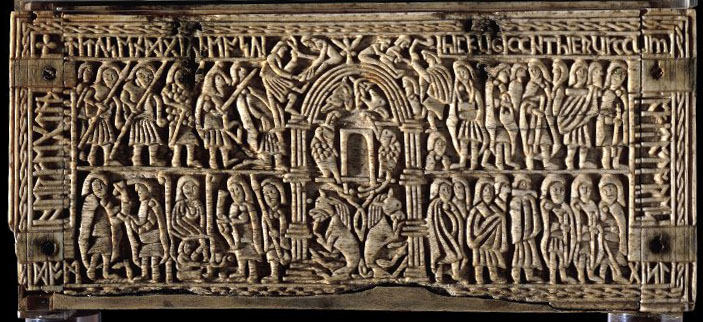
The front panel represents the world's progress from paganism to Christianity, but specifically that of England from the dark (5th century) days of Hengist and Horsa to those of modern (8th century) Northumbria.
Altogether, the Casket is a tribute to the founding and destiny of England. Crucial pieces of the story have already been recognized by Josef Strzygowski, Karl Schneider, and especially A.C. Bouman, but none of these scholars succeeded in pulling all the pieces together.

Figure 2. Right side
Photo courtesy Bargello Museum, Florence
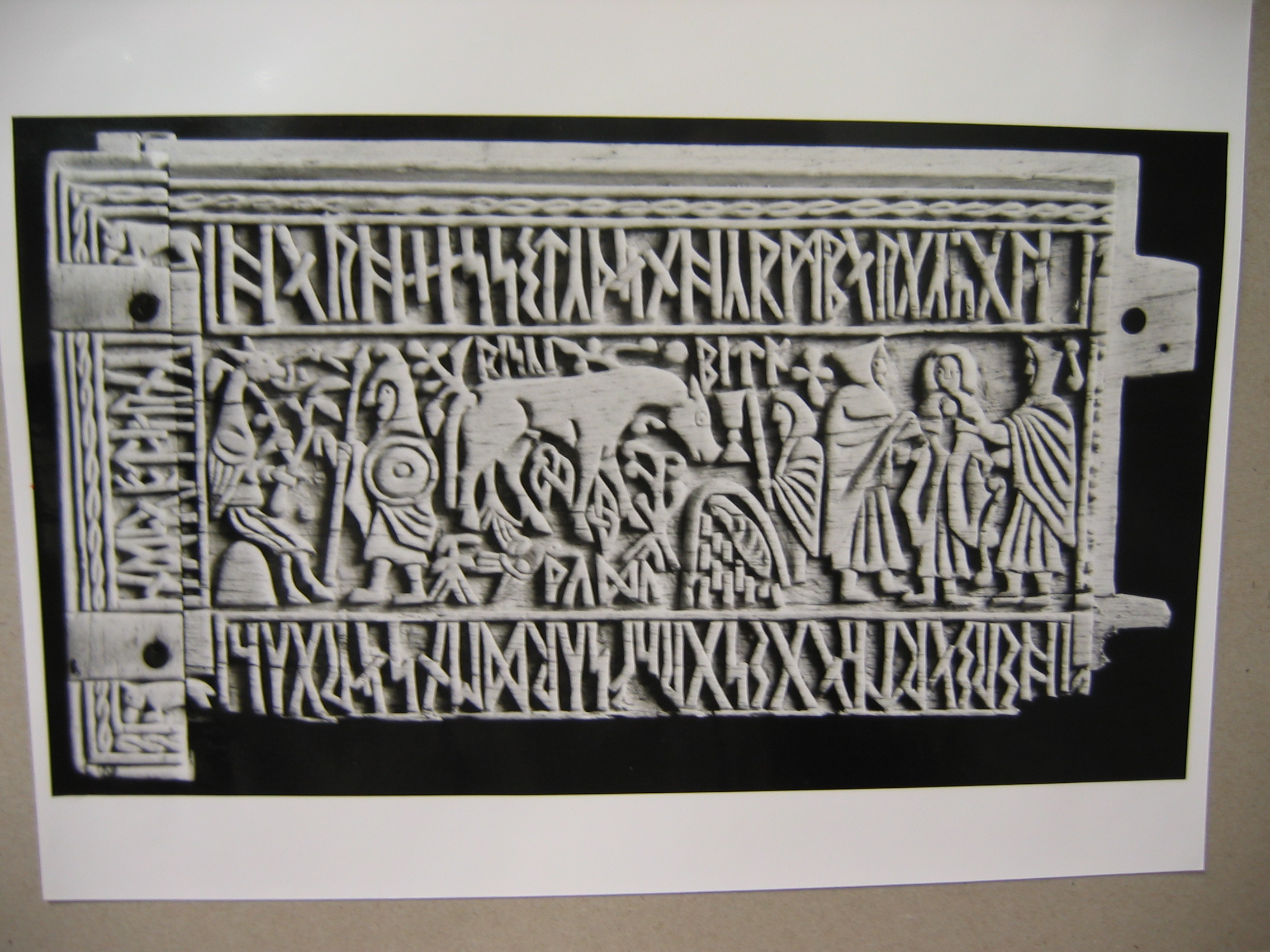
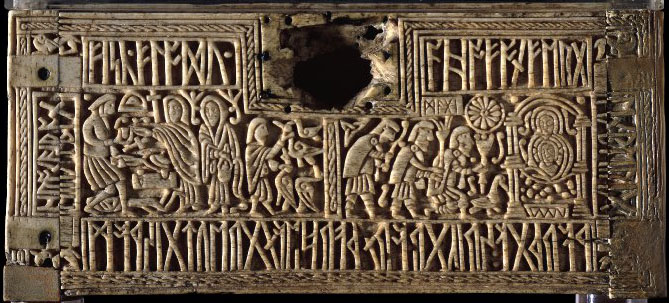
This "Bargello Panel," as it is known, was first correctly identified with Hengist and Horsa, the traditional founders of England, by A.C. Bouman (1965). According to both Bede and the Anglo-Saxon Chronicle, Vortigern, king of the Britons, invited the two brothers Hengist and Horsa to bring a force of Old Saxons, Angles and Jutes to Britain to help him fight against the Picts in the north. Soon war broke out between the Anglo-Saxons and the Britons, and in 455,
Hengest and Horsa fought against King Vortigern at a place which is called Aegelesthrep and his brother Horsa was slain. And after that Hengest succeeded to the kingdom ... [Garmonsway 1954, pp 12-13].Hengist (often spelled Hengest) thus became the first King of the English, albeit not of all of present-day England. Aegelesthrep has been identified with Aylesthorpe, a village near Aylesford in Kent.
At the center of the panel stands a mournful and obviously male horse grieving over a mound that contains a miniature person. Bouman identifies this stallion with Hengist, whose name literally means stallion in Anglo-Saxon. Indeed, "Hengst" (stallion) is precisely the modern German word Becker (1973) uses to describe this animal. Bouman observes that the figure inside the mound would then be Hengist's recently departed brother Horsa, whose name means horse.
Between the stallion's legs are two symbols that have been identified by both Bouman and Neuman de Vegvar (1987) as the trefoil form of the Woden Knot. This often appears in Germanic art to indicate a deceased warrior and/or a specific reference to Woden (Odin). According to both Bede and the Chronicle, Woden was the great-grandfather of Hengist and Horsa. Neuman de Vegvar identifies the bird under the stallion's hind legs as a raven, yet another symbol of Woden.
Bouman, quoting A.G. von Hamel, observes, "'No doubt Horsa is said to have fallen at Aegeles Threp because of his sepulchral monument in the neighborhood, which is mentioned by Bede; it has been identified by Plummer with the flint heap of Horsted near Aylesford.'" Bouman notes that Horsted means horse's stead, i.e. Horsa's place, the burial place of Horsa. It is significant that the image of the mound contains stones suggestive of flint nodules.
Bouman notes that as a pagan, "A Christian burial will not have been given to Horsa, and in the life here-after he must have suffered, according to later Christian belief." Horsa inside the mound is therefore not resting in peace, as would a good Christian, but instead is praying fervently in the hope of a belated redemption.
Horsa's death would surely have been a bitter cup for Hengist to swallow, and indeed before horse-Hengist's eyes there is a cup, with the runic word bita over it. Although this word is usually usually translated "biter," and bitter is normally biter in Anglo-Saxon, Klein (1971) notes that the two words are closely related, bitter being that which bites the tongue.
The figure bearing a staff standing in front of horse-Hengist is dressed as a woman, according to both Bouman and Neuman de Vegvar (1987). Bouman cogently suggests that she is Hengist's famous daughter Renwein, whom we shall encounter again shortly, on the lid.
Over and under horse-Hengist are runic words meaning woods (wudu) and rushes (risci). Evidently the wind made a mournful sound as it blew through them at Horsted.
Figure 3. Detail of Right Side
Photo courtesy Bargello Museum
In the scene at the left end of the right panel, a strange creature with the head of a horse, the body of a man, and the wings of a spirit sits on a mound. Over its head, the partially encrypted runic inscription begins, "Here Hos sitteth on the sorrow-mound." Bouman "emends" Hos to read Hors, and concludes,
We remember Souers' remark about the repetition of one and the same figure in one scene in different functions. This can also be made to apply to this panel: the figure sitting on the hill (mound) and the one over whom the stallion droops its head can both represent a lost companion, each time in a different situation. Seeing that both the stallion and the man with the horse's head are "horses", the solution lies close at hand: one horse mourns the other, Hengest sorrows over the fallen Horsa. Both hills represent Horsted, Horsa lying buried in the one and sitting on the other. (1965, pp. 246-7)Bouman is undoubtedly right, but as any viewer of the 1960s TV series Bonanza would know, hoss requires no emendation to mean horse, and can even be a man's nickname.
Before Hos-Horsa respectfully stands a warrior with a spear, a round shield, and a distinctive helmet with noseguard and forward-tipping crest. But if Horsa can appear twice on the same panel, once as a man and once as a horse, then so can Hengist. The warrior then must be Hengist again, this time as a man. He longs in vain for Horsa to guide him, but (as first noted by Simmons 2010) spirit-Horsa's muzzle is bound by the coils of a serpent that only mocks him.
Spirit-Horsa is clutching a branch whose leaves look like bay laurel, a symbol of victory. Evidently he is silently extending the prospect of future victories to Hengist.
In a scene at the right end of the Bargello panel stand three hooded figures. R.W.V. Elliott (as cited by Bouman) has suggested that these are the three Norns, or "fateful sisters" of Northern mythology. One looks to the left, into the past legacy and antecedants of England depicted on the other panels, one forward into the then present days of Hengist and Horsa, and one to the right, into the glorious "Golden Age of Northumbria" yet to come.
Prior to Bouman, many scholars believed that the right panel pertained to the death of Sigurd and his horse Grani (e.g. Clark 1930). The British Museum (Research/Collection Datasets page) simply states that "The apparently episodic scene is evidently from Germanic legend but has not been satisfactorily identified." Bouman wryly observes,
The artist, according to the explanations given so far of the carvings on the lid, the front and the right side – the back and the left side leaving no doubt about their meaning – shows his interest in Biblical and Roman history as well as in Germanic legend. But he does not seem to be interested in anything from the history or legend of his own country.He adds that there is a miniature horse in each corner of the right panel, as an additional clue for any observer who hasn't yet figured out that it is about two very famous "horses."
Figure 4. Lid
© Trustees of the British Museum
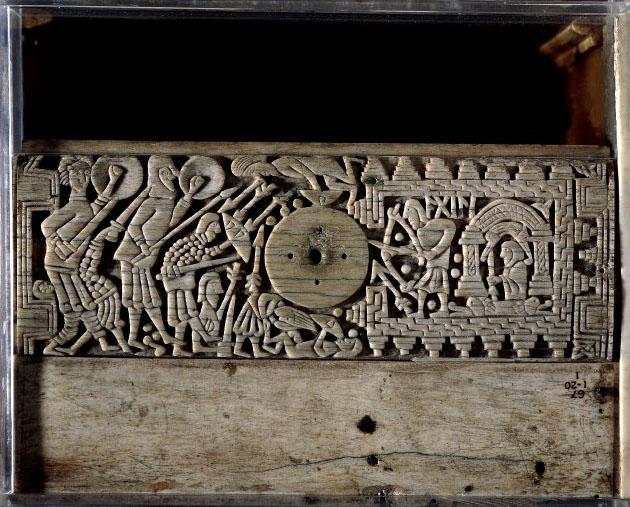
The surviving middle portion depicts warriors on the left attacking a structure with small triangular crenelations on the right. A defender inside the structure is drawing an arrow to shoot at the attackers. Arrows and sling-stones are flying through the air and have already killed some of the attackers.
Vandersall (1975) astutely observes that the lid scene also has larger, square crenelations along both the left and right edges. There is plenty of space for these to have continued above and below on the now-lost portions of the lid, and still to have left room for two lines of runes. The attackers are therefore already within the outer walls of a great city, and the archer is shooting from an inner palace or citadel.
Prof. Josef Strzygowski of Graz (quoted by Viëtor 1904) was the first to propose that the lid represents a scene from the Trojan War. Indeed, the layout immediately brings to mind the death of Achilles at the hands of Paris after he had led the Greeks into the city and almost taken it.
Unfortunately, the famous death of Achilles is not in the Iliad, which cuts off with the funeral of Hector. This story is rather from a long-lost portion of the Epic Cycle known as the Aethiopis. However, it was retold by many ancient authors (with some variation in details), so that the basic story has come down to us.
According to a brief summary by Hesiod, after Achilles has killed the Amazon Penthesileia,
A battle takes place in which Antilochus is slain by Memnon and Memnon by Achilles. Eos then obtains of Zeus and bestows upon her son immortality; but Achilles routs the Trojans, and, rushing into the city with them, is killed by Paris and Apollo. A great struggle for the body then follows, Aias [Ajax] taking up the body and carrying it to the ships, while Odysseus drives off the Trojans behind. (tr. Evelyn-White, 1982, p. 507)In Ovid's famous Metamorphoses, Neptune appeals to Apollo to destroy Achilles:
And now, when the war against Troy had lasted for almost ten years, he called to Sminthean Apollo, the unshorn, in these words: 'O, by far the best loved of my brother's sons, who built the walls of Troy with me, to no purpose, do you sigh at all to see these battlements at the moment of their destruction? Do you grieve at all that so many thousands died defending her walls? Not to name all of them, does not the shade come before you of Hector, dragged round his own citadel, Pergama? But savage Achilles, more cruel than war itself, is still alive, ravager of our creation. Let him be given up to me. I would let him feel what I can do with my three-pronged spear: but since I am not allowed to meet face to face with the enemy, destroy him unexpectedly with a hidden arrow!'Achilles thus died in a battle that raged inside the already doomed battlements of Troy, by means of a hidden arrow shot by the cowardly Paris. The archer inside the interior palace or citadel therefore must be Paris. Even though the archer is dishing out considerable damage to the attackers, he is hiding, Paris-like, inside the citadel, unlike the bold warrior on the far left who is seemingly oblivious to danger, even to the point of not wearing a helmet in what is obviously a hard-hat zone. This warrior must therefore represent Achilles.The Delian god [Apollo] nodded, and satisfying his own and his uncle's desire, he came to the Trojan lines, wrapped in a cloud, and there, among human massacre, he saw Paris firing infrequent shafts at unknown Greeks. Showing himself as a god, he said: 'Why waste your arrows on the blood of the rank and file? If you care for your own, aim at Achilles, grandson of Aeacus, and avenge your dead brothers!' He spoke, and, pointing to Pelides [Achilles, son of Peleus], who, with his weapon, was strewing the ground with Trojan bodies, he turned Paris's bow towards him, and guided the unerring shaft with deadly hand....
So, Achilles, conqueror of so much greatness, you are conquered, by the cowardly thief of the wife of a Greek! [Bk XII:579-628, tr. Kline 2000]
The seated figure holding a staff in the bower behind Paris has been identified as a woman by both Neuman de Vegvar (1987) and Simmons (2010). In terms of the Trojan War she must therefore be the famous "Grecian wife" Helen, whose abduction set off the conflict in the first place.
Vandersall notes that "The two fallen warriors clutching shields above and below the disk are nude. Depicting the fallen as nude is a normal occurrence in antique art and doubtless arises from the practice of stripping the fallen of their armor" (1975, p. 17). A grieving man is bent over the fallen warrior at the bottom, holding his extended hand to his face. Carl Schlam of Ohio State University (personal communication) has suggested that this is King Priam of Troy mourning his son Hector. However, his fine hair falling forward resembles that of "Achilles" on left, so it is more likely that this is Achilles again, lamenting the earlier death of his friend Patroclus. As on the right and front panels, there is no reason the same person cannot appear twice in the same scene, at different times. The fallen warrior above the now-missing center knob, on the other side of the battlefield so to speak, would then most likely be Hector, who killed Patroclus, and who then was killed by Achilles.
The word AeXili appears in runic letters over the shoulder of Paris. Here, I use an upper case chi (X) to represent the chi-like gyf rune that is used on the Casket to represent both a /g/ sound as in the word MaeXi over the Magi on the front panel, and a gutteral /gh/ sound in the word feXtath or "fighteth" on the back panel, similar to the /gh/ in Irish lough or the /ch/ in Scottish loch or German fechtet.
Schneider (1959) has lucidly proposed that AeXili is a reference to Achilles. He notes that as Anglo-Saxon, it could either be the nominative singular or dative singular of an i-stem noun. In the former case, it would mean "[This is] Achilles," and in the latter, "[This is for or belongs to] Achilles." The reference to Achilles is confirmed by Vandersall (1975).
Since the word AeXili appears over the archer Paris, it cannot be identifying him in the nominative as Achilles. Instead, it must be an indication in the dative that the arrow Paris is about to shoot is meant for Achilles. Don Lateiner of Ohio State University (personal communication) has observed that it was not uncommon in antiquity for weapons to be labeled with the name of an enemy, in the dative.
The word AeXili on the lid, customarily transcribed Aegili, was the clue that led Bouman to connect the right panel with Hengist and Horsa, since Horsa died at a place known, or that became known, as Aegelesthrep, i.e. Aegel's thorpe or village, now Aylesthorpe near Aylesford in Kent. However, Bouman, who does not mention Schneider's reading of this word as Achilles, erroneously concluded that the lid actually depicted the 5th century battle between the English and Britons. In fact, it literally depicts the death of Achilles inside Troy, and only metaphorically represents the 5th century battle, which must have been named for Achilles because of the analogy between the death of Achilles and that of Horsa.
Simmons (2010, p. 56) finds it remarkable that although there is not one instance of an actual person named "Aegel" in the Old English corpus, numerous places are named for this individual. In addition to Aegelsthrep/Aylesthorp (Aegel's village) and Aylesford (Aegel's ford) he finds Aylesbeare (Aegel's grove), Aylesbury (Aegel's fort), Aylesham and Aylsham (Aegel's home), and Aylestone (Aegel's town). But if Horsa is figuratively Achilles, then all these places are indirectly named for Horsa.
Using the Trojan War as a metaphor for the Anglo-British War was particularly natural in light of the British tradition that Britain was founded by and named for a Brutus who was supposed to have been a grandson of the Trojan Aeneas. According to Geoffrey Ashe (1990, Ch. 2), this tradition was first recorded in the ninth century Historia Brittonum ascribed to "Nennius." However, it would not be surprising if it went back at least to Roman times.
Ashe reports that a distinctive maze appears at Tintagel and elsewhere, consisting of 7 concentric circles with a convoluted path leading to the center: "Its traditional Welsh name is Caerdroia, meaning the City (or Fortification) of Troy. Allegedly, the maze is a plan of Troy's defenses, with seven walls and a laborious way through them." (1990, pp. 66-67). The British tribe named the Trinovantes (presumably New Trojans) were said to have founded London as "Troia Nova" (p. 20), while on the Continent, Gaulish tribes similarly lent their names to the cities of Paris and Troyes.
The ancient Britons therefore not only knew about Troy, but, like the Romans, actually thought that they were Trojans. They may in truth have been no more Trojan than the average USC undergraduate, and have just picked this notion up from the Romans. But all that is relevant is that they thought of themselves as Trojans.
In the first few years of the English presence in Britain, when Hengist and Horsa were fighting in the service of Vortigern against the Picts, rather than against him, relations were so cordial that Hengist actually married his beautiful daughter Renwein off to Vortigern, in exchange for Kent (Ashe, p. 174). During this period of social and cultural interaction, the Britons would have been certain to have rubbed the noses of the Saxon bumpkins in their superior Trojan pedigree.
Now if the Britons regarded themselves as Trojans, their ultimately triumphant arch-rivals, the Anglo-Saxons, would metaphorically be the Greeks. The lid, therefore, by depicting the conquest of Troy by the Greeks, in fact symbolizes the conquest of Britain by the English. The most memorable war in human history is a metaphor for what at the time was the most memorable war in English history.
If Achilles represents Horsa at the left end of the scene, who is the equal-statured warrior to his right? He is carrying a round shield and spear and is wearing a helmet with a distinctive nose guard, just like man-Hengist on the right panel. The top of his helmet extends into the missing upper panel of the lid, but it is consistent with the forward-tipping crest on Hengist's helm. This is therefore an important Greek who is depicted as if he were Hengist.
Hesiod (above) specifically mentions two Greek heroes who were present at the death of Achilles: Ajax and Odysseus. Of these, Odysseus makes perfect sense, because of another story about Hengist: After several defeats at the hands of Vortimer, Hengist invited Vortigern and his nobles to a peace parlay at Amesbury. At the conference, the Saxons pulled daggers out of their boots and slaughtered 300 to 400 Britons. (Ashe, 174-5). The Long Knives of Hengist may have been deceitful, but they worked, just as effectively as the Trojan Horse of Odysseus: Beware of Greeks bearing gifts, and of Englishmen wearing boots!
Renwein's marriage to Vortigern even lends a Helen angle to the metaphor: Helen seated in the room behind the archer Paris looks just like Renwein standing before horse-Hengist on the right panel, and she is even holding the same staff. Renwein was not exactly abducted by Vortigern, but their marriage probably turned sour after war broke out between her father and her husband and she had poisoned Vortimer, Vortigern's son by a previous marriage (Ashe, p. 174). Simmons (p. 51) notes that there is another trefoil Woden's Knot over this "Helen." This would be entirely appropriate for a "Greek wife" if she happened to be descended from Woden via Hengist. Continuing the metaphor, the archer Paris then represents Vortigern.
Although Schneider was the first to correctly read AeXili as a reference to Achilles, he mis-interpreted the archer to be Achilles. He took the dative word form as meaning "[this belongs to] Achilles", and interpreted it as referring to the citadel of Thebes that Achilles seized from Andromache's father Eëtion in an obscure story from the Iliad (Lattimore, trans., p. 164). He goes on to interpret seven of the eight figures on the left to be Andromache's seven brothers, all of whom Achilles slaughtered, according to Andromache's sad story. The woman in the bower would then be Andromache's mother.
However, Schneider neglected to mention that Achilles slaughtered the brothers, not as they attacked him in the citadel of Thebes, but rather out in the fields, "as they were tending their white sheep and their lumbering oxen." These sheep and oxen are conspicuously absent from the scene on the lid. The "brothers" are not dressed for pastoral activities, but rather are armed to the teeth. To account for the eighth person on the left, Schneider would have the naked figure over the handle be Andromache herself, fleeing from the scene of the carnage. Becker (1973) has already objected that this bearded figure could hardly be a woman. Furthermore, there is no particular reason to think that Achilles used a bow and arrow to kill the brothers.
Vandersall (1975) accepts Schneider's reading of AeXili as a reference to Achilles, but would instead have the battle on the lid be the fierce attack on the Greek camp and ships by the Trojans that is recounted in the Iliad. She interprets the archer as the Greek bowman Teucer, and the (female?) figure behind him as Achilles seated in his tent. While it is true that the illustrated Ambrosian Iliad that she cites does (implausibly) depict the Greek camp as a cut-stone fortress, there are no Greek ships in the background on the lid of the Franks Casket. The death of Achilles by the hidden arrow of Paris is a much better fit to its iconography.
Although Strzygowski was the first to associate the lid with the Trojan War, the terse "preliminary thought" that he conveyed to Viëtor was that it represented the "fall of Troy." Vandersall objects that the lid could not be depicting the fall of Troy per se, since the famous Trojan Horse of Odysseus is nowhere in sight. However, I am willing to give Strzygowski the benefit of the doubt, and to take him to have had in mind the imminent "moment of the destruction" of the battlements of Troy, as Ovid put it when Achilles was routing the Trojans, rather than the very instant of their fall by the ruse of Odysseus.
Apollodorus and others add the famous detail that Achilles died of an arrow to his vulnerable ankle (J.G. Frazer 1921, Epitome, 5.3 and esp. fn. 111). However, there is no allusion to this on the Franks Casket lid. Indeed, the figure behind "grieving Achilles" has just taken an arrow in the chest. It is quite possible that this is Horsa-Achilles again, at the moment of his own death.
Although the traditional story of the death of Achilles, as recounted by Hesiod and Ovid, has him die in battle after he stormed into the city, two accounts, allegedly by the eye-witnesses Dictys of Crete and Dares the Phrygian but probably from the first century A.D., would instead have him ambushed in the temple of Apollo outside the walls of Troy where he had come in peace to bargain for the hand of the Trojan princess Polyxena in marriage (R.M. Frazer, 1966). Although these accounts became very influential in the Troy-obsessed later medieval literature, the Franks Casket lid clearly follows the traditional version.
Figure 5. Left Panel
© Trustees of the British Museum
Neuman de Vegvar (1999) observes that the Romulus and Remus theme is common in later Anglo-Saxon art, and is often featured as a royal symbol on coins. She notes that Romulus and Remus, the two brothers who founded Rome, have a parallel in none other than Hengist and Horsa, the two brothers who founded England, and concludes, "So the legend of a pair of outcast or traveller brothers who led a people and contributed to the formation of a kingdom was probably not unfamiliar in the 8th-century Anglo-Saxon milieu of the Franks Casket and could stand as a reference to destined rulership."
However, she fails to note that Bouman had already demonstrated that Hengist and Horsa are in fact the subject of the right panel and, as I would argue, of the entire Casket. Romulus and Remus are therefore on the Casket precisely because of their analogy to Hengist and Horsa. The message is that England, having been founded by two alliterative brothers with an animal trait, will one day be as great as Rome, which was likewise founded by two alliterative brothers with an animal trait. In all likelihood, the Romulus and Remus theme was continued in later Anglo-Saxon art not just to liken the English kingdoms to Rome, but also to invoke the Hengist and Horsa simile.
Neuman de Vegvar notes that the second wolf at the top of the panel is problematic, because in the traditional stories, there is only a she-wolf. But the wolf was yet another symbol of Woden. Perhaps the second wolf represents the great-grandfather of the English Romulus and Remus. It is noteworthy in this respect that the Roman Hengist and Horsa also claimed divine ancestry: their father was either Mars or the demigod Hercules.
Simmons (2010) observes that the reverential kneeling posture of the four men echoes that of the Magi on the front panel (discussed below). Such was the future greatness of the nation founded by R&R, and metaphorically of that founded by H&H.
It is anomalous that the two brothers being nursed by the she-wolf are already young men. Perhaps this is to remind us that the English Romulus and Remus arrived in their adopted home, "far from their native land," not as infants but as full grown adults.

Figure 6. Rear Panel
© Trustees of the British Museum
The caption to the right reads, in Latin language but partly in Roman letters and partly in runic letters, "Here flee the inhabitants of Jerusalem." Beneath this text a group of refugees leaves the city. Simmons notes that in the faces of the three who turn their heads, "we perceive a great melancholy as they look back on the temple" (2010, p. 31).
At the bottom left, the runic word dom (judgement, cp. doom) appears. In the adjacent scene, a seated judge is passing judgement on a prisoner. At the bottom right, we have the word gisl (hostages), and a group of captives is being led away. Neuman de Vegvar notes that "the central one, a woman, wears a heavy neck ring or yoke." (1987, p. 267)
The Temple at the center of the panel encloses the Holy of Holies, but it is significantly empty of the Ark of the Covenant.
In the context of the rear panel, James Lang (1999) calls attention to Matthew 23-24. There, Jesus six times exclaims, "Woe to you, scribes and Pharisees and hypocrites," while enumerating their sins. He then laments, "O Jerusalem, Jerusalem, thou that killest prophets and stonest them that are sent to thee, how often would I have gathered thy children together, even as a hen gathereth her chickens under her wings, and ye would not. Behold, your house is left unto you desolate." Referring to the buildings of the Temple, Jesus then foretells its destruction:
You see all these, do you not? Truly, I say to you, there will not be left here one stone upon another, that will not be thrown down. [Oxford Annotated Bible, emphasis added]In the lower left scene, a scribe, scroll in hand and under armed guard, is receiving sentence from the seated judge. To the left of the judge, serious woe is befalling what evidently is a hypocritical Pharisee.
Lang goes on to describe the theme of the panel as
Titus's destruction of Jerusalem, prophesied by Christ upon the city that had used him ill. It comes very close to divine revenge, a constant theme in the psalms, and the gospel passage interestingly refers to the empty Temple and the dispersal of the Jews, as depicted on the back of the casket. (1999, 250-1)Leslie Webster writes with respect to the destruction of the Second Temple,
As well as prefiguring the divine temple which is encapsulated in the incarnate body of Christ, and the community of the church on earth, the Temple featured in exegesis in many other ways; for Bede, for example, its destruction was also seen as a turning point in the history of the church and its forms of worship (Plummer 1896, II, 190).Thus even though Titus was a pagan, he acted as a divine instrument in destroying the Temple, because he fulfilled the prophesy of Jesus, punished the Jerusalemites for stoning and killing prophets and for their failure to embrace Jesus, and cleared the way for the new order of Christianity.The casket's central image [on the back panel], then, is a complex symbol – at one level, it represents the continuity of the universal church, and its earthly community; at another, the destruction of the Temple at the hands of the Roman, Titus, seems to contain within it a prefiguration of the new order in which the church is established in Rome. Bede, in his homily for the aniversary of the dedication of Jarrow (O'Reilly 1995, xix, xxix, xlvii), certainly discusses the successive destruction sof the Temple as things ordained 'as an example for us' (citing I Cor, 10-11). Thus the very destruction may serve as an image of the continuity of the universal church which is continually renewed in the body of its members (1999, p. 238).
Turning now to 8th century Northumbria, Bede tells us in his Ecclesiastical History that the Britons were likewise sinful and that their destruction at the hands of the Anglo-Saxon hordes was part of a similar divine plan: During an interlude of peace and prosperity before their arrival, he reports that the Britons fell into luxury, leading to "cruelty, hatred of truth, and love of falsehood." Even the clergy became addicted to "drunkenness, animosity, litigiousness, contention, envy, and other such crimes, and casting off the light yoke of Christ." And if these sins weren't enough, they celebrated Easter on the wrong day, and shaved their tonsures incorrectly.
The Britons were first punished by a severe plague,
which soon destroyed such numbers of them, that the living were barely sufficient to bury the dead.... Whereupon, not long after, a more severe vengeance, for their horrid wickedness, fell upon the sinful nation. They consulted what was to be done, and where they should seek assistance to prevent or repel the cruel and frequent incursions of the northern nations; and they all agreed with their king Vortigern to call over to their aid, from the parts beyond the sea, the Saxon nation; which, as the event still more evidently showed, appears to have been done by the appointment of our Lord Himself, that evil might fall upon them for their wicked deeds. (Bede, Ecclesiastical History, Ch. XIV, emphasis added)Soon after Hengist and Horsa had led the Saxons, Angles, and Jutes into Britain,
swarms of the aforesaid nations came over into the island, and they began to increase so much, that they became terrible to the natives themselves who had invited them. Then, having on a sudden entered into league with the Picts, whom they had by this time repelled by the force of their arms, they began to turn their weapons against their confederates. At first, they obliged them to furnish a greater quantity of provisions; and, seeking an occasion to quarrel, protested, that unless more plentiful supplies were brought them, they would break the confederacy, and ravage all the island; nor were they backward in putting their threats in execution. In short, the fire kindled by the hands of these pagans, proved God's just revenge for the crimes of the people; not unlike that which, being once lighted by the Chaldeans, consumed the walls and city of Jerusalem. For the barbarous conquerors acting here in the same manner, or rather the just Judge ordaining that they should so act, they plundered all the neighbouring cities and country... (Bede, EH, Chap. XV, emphasis added)Some of the defeated Britons, "spent with hunger, came forth and submitted themselves to the enemy for food, being destined to undergo perpetual servitude," much as the Judean hostages in the lower right scene on the rear panel were enslaved. "Some, with sorrowful hearts, fled beyond the seas," much like the fleeing inhabitants in the upper right scene of the panel.
In Bede's mind, therefore, the English, as led by Hengist and Horsa, were a scourge sent by God to bring a just revenge upon the wicked British, just as the Chaldeans were sent to punish the wicked First Temple Judeans, and just as the Romans led by Titus were sent to chasten the sinful Second Temple Jews. The Franks Casket, by its choice of topic for the rear panel, appears to be endorsing Bede's point of view.
Titus on the Franks Casket is wearing the same distinctive helmet with noseguard and forward-tipping crest as man-Hengist on the right panel and as Odysseus-Hengist on the lid. Titus is therefore metaphorically Hengist, in that both carried out a similar divinely-ordained mission.

Figure 7. Front Panel
© Trustees of the British Museum
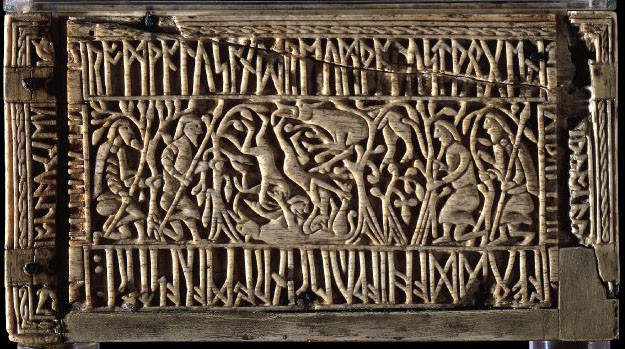
The left half is not so obvious to modern observers, but Souers (1943) has pointed out that contemporaries would have recognized this as the pagan legend of the revenge of Wayland the Smith. Wayland was a master goldsmith whose work was so admired by King Nithhad that the king enslaved him, and had him hamstrung to ensure he could not escape. Wayland (aka Weyland, Welund, Wieland, Volundr) eventually took revenge by beheading the king's two sons and forging their skulls into cups that he tricked the king into drinking from. He made their eyes into jewels for the Queen, and then raped and impregnated their daughter Beaduhild after plying her with drugged beer. Once Nithhad's spell over him was broken by these terrible acts, he either transformed himself into a bird or donned a feathered suit and flew away.
On the Casket, Wayland is in his smithy, with the headless body of one of the sons on the floor beneath his anvil. With one hand he brandishes the son's skull in a pair of tongs, while with the other he offers Beaduhild the drugged beer. The ominous noodle of vapor rising from the beer is a particularly nice touch. It has been suggested that the second woman behind Beaduhild may be her maid and that the man strangling birds behind her may be Wayland's brother Egil, collecting feathers for his escape.
The front panel clearly contrasts paganism's hateful gifts of revenge to Christianity's gifts of love. But set in the context of the rest of the Casket, it is specifically contrasting the dark pagan days of Hengist and Horsa to the enlightened Christianity of Bede's Northumbria.
Simmons (2010) observes that yet another Woden's knot appears behind the third Magus. Its position suggests that paganism, as represented by Woden's own descendants Hengist and Horsa, is literally being left behind.

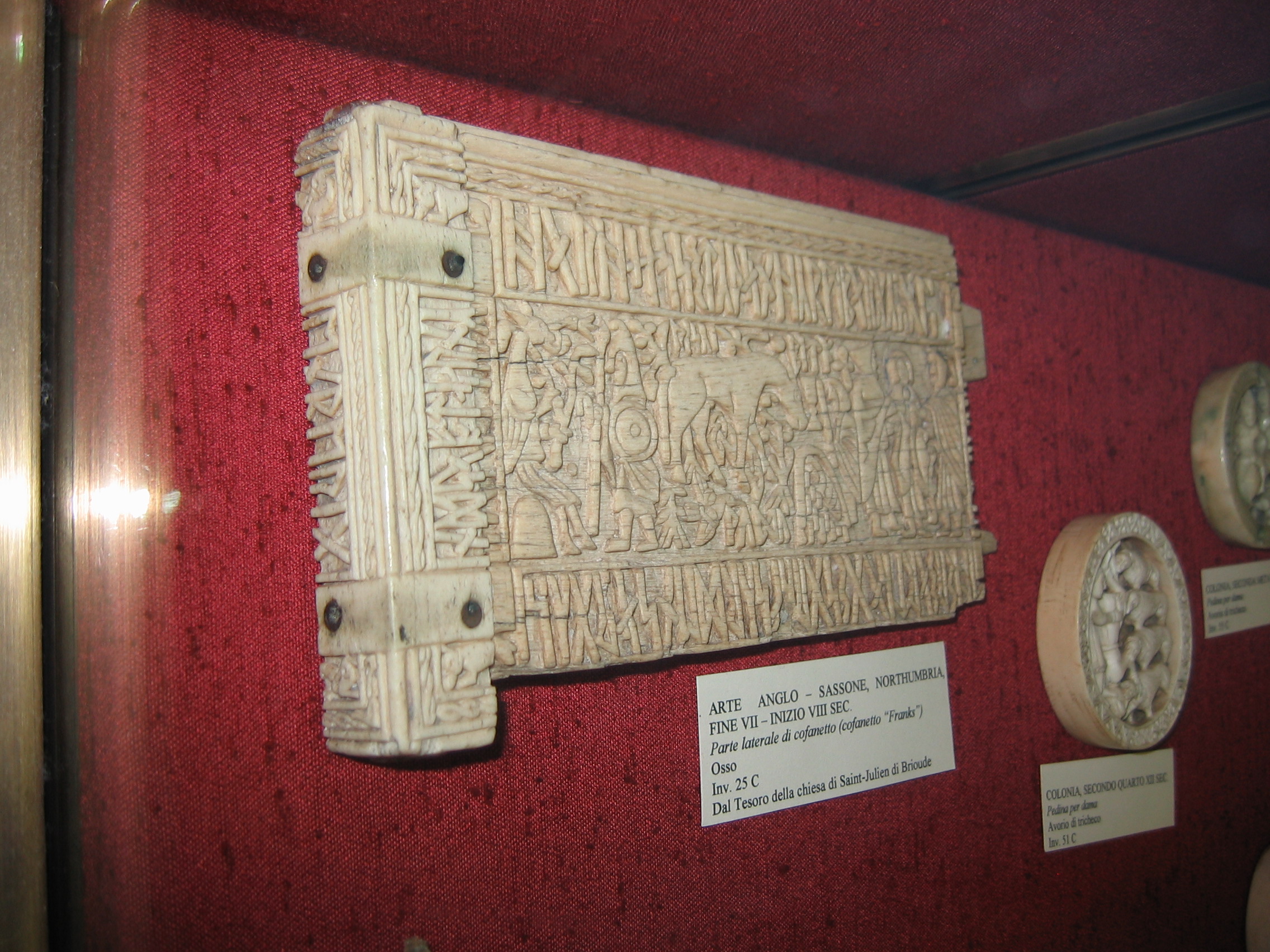
Figure 8. The Bargello Panel
Photo J. Huston McCulloch
The cast in the British Museum is better than nothing, but it is decidedly inferior to the original. Compare Figures 2 and 3 above to the cast at www.archeurope.com/index.php?page=the-franks-casket-right-panel
Perhaps one day the British Museum will acquire this unique tribute to the founding of England, and will reunite it with the other four panels.
Beard, David. Archaeology in Europe: The Franks Casket , www.archeurope.com. Excellent photographs of the Casket.
Becker, Alfred. Franks Casket, Zu den Bildern und Inschriften des Runen Kästchens von Auzon. Regensburg, 1973.
Becker, Alfred. Franks Casket www.franks-casket.de, accessed June 24, 2004. Explores magical and numerological significance of the runic inscriptions.
Bede, the Venerable, Saint. Bede's Ecclesiastical History of the English Nation, c. 731, translated 1723 by J. Stevens. Everyman's Library, Dent, London, 1965.
Bouman, A.C., "The Franks Casket," Neophilologus 3 (1965): 241-9.
British Museum, "The Franks Casket," http://www.britishmuseum.org/explore/highlights/highlight_objects/pe_mla/t/the_franks_casket.aspx, non-technical Explore/Highlights webpage, with 4 low-resolution photographs.
British Museum, "The Franks Casket / The Auzon Casket," http://www.britishmuseum.org/research/search_the_collection_database/search_object_details.aspx?objectid=92560&partid=1, more technical Research/Collection Database webpage, with 35 higher resolution photographs.
Clark, Eleanor Grace. "The Right Side of the Franks Casket," Publications of the Modern Language Association of America 45 (1930): 339-353.
Frazer, J.G., translator. Apollodorus, the Library. Loeb Classical Library, Harvard, 1921. Online at http://www.theoi.com/Text/ApollodorusE.html.
Frazer, R.M., Jr. The Trojan War: The Chronicles of Dictys of Crete and Dares the Phrygian. Bloomington: Indiana University Press, 1966.
Garmonsway, G.N., translator. The Anglo-Saxon Chronicle. London: J.M. Dent & sons, Ltd, 1954.
Hawkes, Jane, and Susan Mills, Northumbria's Golden Age, Sutton Publishing, Phoenix Mill Thrupp, Strand, Gloucestershire, 1999.
Hesiod. The Homeric Hymns and Homerica, translated by Hugh G. Evelyn-White. Cambridge, Harvard University Press, 1982.
Klein, Ernest. A Comprehensive Etymological Dictionary of the English Language. Elsevier, London, 1971.
Kline, Anthony S., translator. Ovid's
Metamorphoses.
Lang, James. "The Imagery of the Franks Casket: Another Approach." Ch. 20 in Hawkes and Mills (1999), pp. 247-255.
Lattimore, Richard, translator. The Iliad of Homer. University of Chicago Press, 1962.
Neuman de Vegvar, Carol L. The Northumbrian Renaissance: A Study in the Transmission of Style. Selingrove: Susquehanna University Press, 1987.
Neuman de Vegvar, Carol L. "The Travelling Twins: Romulus and Remus in Anglo-Saxon England." Ch. 21 in Hawkes and Mills (1999), pp. 256-267.
O'Reilly, Jennifer. Introduction to Bede: On the Temple. Liverpool University Press, 1995.
Plummer, Carolus, editor, Venerabilis Baedae. Historiam Ecclesiasticum Gentis Anglorum. Oxonii, E Typographeo Clarendoniano, M DCCC XCVI.
Schneider, Karl. "Zu den Inschriften und Bildern des Franks Casket und einer ae. Version des Mythos von Balders Tod." In Festschrift für Walther Fischer Heidelberg, Universitätsverlag, 1959.
Simmons, Austin. The Cipherment of the Franks Casket. University of Oxford: Woruldhord Project, 2010. http://poppy.nsms.ox.ac.uk/woruldhord/contributions/144.
Souers, Philip Webster. The Wayland Scene on the Franks Casket. Speculum 18 (1943): 104-111.
Treasures of Heaven: Saints, Relics and Devotion in Medieval Europe. The Franks Casket. www.learn.columbia.edu/treasuresofheaven/relics/The-Franks-Casket.php. Accessed Sept. 9, 2012. Excellent "zoomifiable" detailed photograph of rear panel.
Vandersall, Amy L. "Homeric Myth in Early Medieval England: The Lid of the Franks Casket". Studies in Iconography 1 (1975): 2-37.
Viëtor, W. Allgemeinwissenschaftliches; Gelehrten-, Schrift-, Buch- und Bibliothekswesen. Deutsche Literaturzeitung. Vol. 25, 13 Feb. 1904.
Webster, Leslie. "The Iconographic Programme of the Franks Casket." Ch. 19 in Hawkes and Mills (1999), pp 227-246.
Wikipedia. "Bonanza," http://en.wikipedia.org/wiki/Bonanza, accessed Dec. 6, 2012. Includes photograph of Dan Blocker as Eric "Hoss" Cartwright.
Up to Archaeological Outliers page
Simmons reference added 12/9/12.
Improved photo of lid substituted 12/12/13.
Minor corrections, 12/18/12.
Improved photos of left side, front and back substituted, Clark and second British Museum references added, minor errors corrected, 12/20,12.